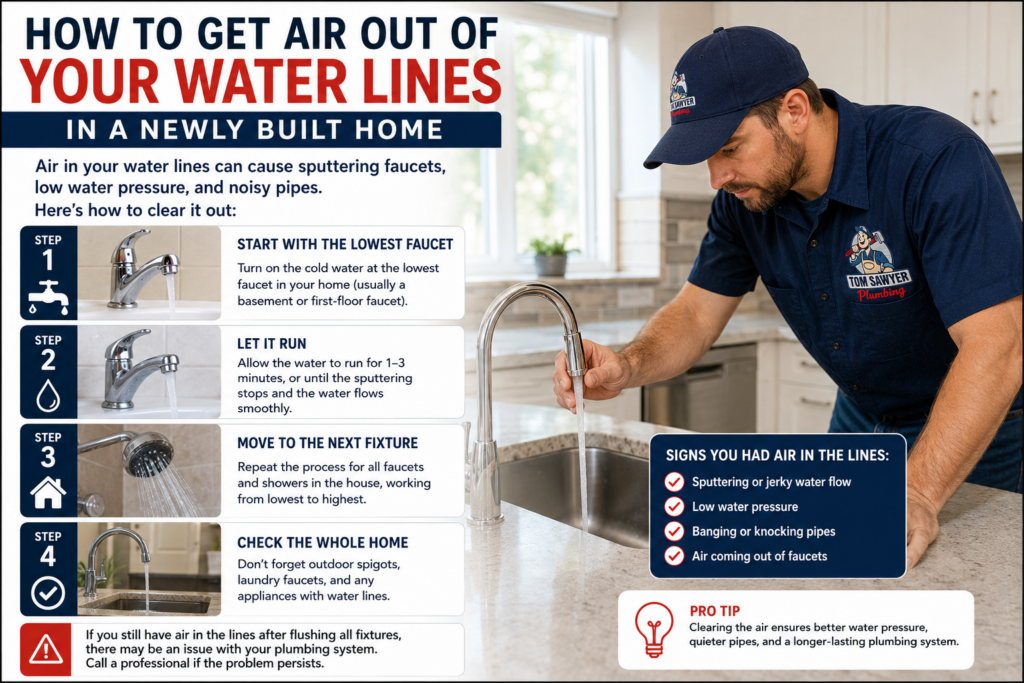
Quick Answer: To get air out of your water lines, shut off the main water shut-off valve, open all faucets / taps (hot and cold), drain the plumbing system, then slowly reopen the main water supply valve and run water until the steady stream returns. Start with the highest faucet and work down to the lowest faucet. Flush toilets 2-3 times to clear trapped air from toilets (flush tanks). If you still get sputtering faucets, fluctuating water pressure, or gurgling noises, inspect for leaks (suction-side leak concept), valve issues, and pressure changes / municipal water main work.
Table of Contents
Why New Homes Get Air Pockets After the First Water Turn-On
New plumbing often traps air pockets and air bubbles because brand-new lines are filled for the first time, branch lines may sit “dry,” and fixtures introduce small voids.
In a newly built home, air can remain in the water supply line, hot water lines, and cold water lines after initial testing. Even if your builder pressure-tests lines, air can still linger in bends, vertical runs, and long branches.
You may notice air coming out of faucet bursts, a weak start then a surge, or a stop-and-go stream. Sometimes the symptom looks like cloudy water that clears fast, which is often tiny air bubbles, not sediment.
If your goal is how to get air out of your water lines without guesswork, the key is to purge the system in a specific order so the trapped air has a clear escape path.
Fast Symptom Check for Air in Home Water Lines
The most common signs are sputtering faucets, irregular water pressure, and noise like gurgling noises, hissing sounds, or knocking noises.
Listen and look for these symptoms:
- rattling pipes in walls when you open a tap
- banging pipes after you shut a fixture off
- thumping sounds when a valve closes
- inconsistent water flow from one room to another
- low water pressure at one sink but not another
- fluctuating water pressure during showers
These noises can also be described as pipes whistling or even pipes screaming when pressure swings are sharp. In many cases, that’s linked to water hammer, which can happen when air compresses and pressure changes fast.
If you want a simple baseline, run a single faucet. If the stream “spits,” coughs, or pulses, you likely have air in water pipe sections.
Step-by-Step Purge Method for a Newly Built Home
The most reliable method is to shut off the water supply, open every fixture to vent air, fully drain, then refill slowly and close in reverse order.
This is the core get air out of water lines process, designed for new homes with multiple branches.
Full-Home Purge (Most Effective)
- Locate the main water shut-off valve. It’s often near the meter, utility room, or where the line enters the home.
- Shut off the water supply by closing the main water supply valve fully.
- Open every faucets / taps in the home: kitchen, bathrooms, tubs, showers, and any utility sink.
- Open hot and cold on each fixture to vent both hot water lines and cold water lines.
- Open the hose bib / outdoor spigot too, if the weather is safe above freezing.
- Let fixtures run until they sputter and stop. That drains the system and helps clear air pockets.
- Flush toilets 2-3 times to empty toilets (flush tanks) and clear air in those branches.
- Turn the main water supply valve on slowly. This matters. A fast refill can trap air again.
- Start with the highest faucet and let it run until you get a smooth steady stream.
- Work down to the lowest faucet and repeat.
- Finish by close faucets in reverse order (farthest to nearest) to push remaining air toward the main.
Quick Fix Tip: If the flow is mostly steady but still spits at one fixture, leave only that fixture running for 3-5 minutes. It often clears the last air bubbles without redoing the whole home.
What Causes Air in Water Lines
Air enters or remains in plumbing due to filling events, pressure shifts, and openings that let air in faster than water pushes it out.
Here are the most common causes in newly built homes:
- recent plumbing repairs / maintenance during punch-list fixes or fixture swaps
- improper installation that leaves a high spot where air collects
- leaks (suction-side leak concept) that pull air into a line when pressure dips
- pressure changes / municipal water main work in West Chicago and surrounding neighborhoods
- valve closures that cause quick pressure swings and water hammer
Even without a leak, strong pressure swings can make pipes “complain” with hissing sounds, banging pipes, and knocking noises.
If you’re researching how to get air out of your water lines because the home is brand-new, focus on controlled refill and correct venting order first. That solves most cases.
Symptoms, Likely Cause, and Best Fix
|
Symptom you Notice |
Likely Cause |
Best Fix to Try First |
|
sputtering faucets |
trapped air pockets in branches |
Full-home purge steps (highest to lowest) |
|
irregular water pressure |
air + fast refill |
Refill slowly, keep multiple taps open |
|
cloudy water that clears fast |
tiny air bubbles |
Run one tap 2-3 minutes |
|
gurgling noises |
air moving through vertical runs |
Start purge at highest fixture |
|
banging pipes / thumping sounds |
air compression + water hammer |
Slow valve operation, purge, then add arrestors if needed |
|
inconsistent water flow |
air stuck in one branch |
Isolate branch and run it longer |
Air in Pipes Fix for One Bathroom or One Branch Only
If only one bathroom has trouble, you can purge that branch without draining the whole house.
This is the targeted approach when the rest of the home is fine, but one sink or shower spits air coming out of the faucet.
Quick Branch Purge
- Open the problem fixture fully (hot and cold).
- Open one more fixture nearby to give air a second exit path.
- If the fixture is upstairs, start there first (it acts like a vent).
- Let water run until the flow stops spitting and becomes a steady stream.
- Close the nearby fixture first, then the problem fixture.
Quick Fix Tip: If a shower valve is new, open it halfway first. Then full open. Some cartridges vent better when pressure rises gradually.
If your home still struggles after this and you’ve already tried the full-home method, it may be time to consult reliable new construction plumbing experts who can check for installation-related air traps without tearing into walls.
Preventing a Plumbing Air Lock in a Newly Built Home
To prevent a plumbing air lock, refill slowly, vent high points first, and avoid slamming valves shut.
A plumbing air lock happens when air blocks water movement like a bubble “plug.” New homes can see this after the first fill, after a fixture swap, or when the system is drained.
Simple Prevention Habits
- Turn the main water supply valve on slowly after any shutdown.
- Start running water at the highest faucet first.
- Keep at least two fixtures open during refills to vent faster.
- Avoid quick shutoffs that trigger water hammer.
- After a long time away, run a top-floor faucet for 2 minutes.
If you’re planning plumbing upgrades that add value to your home, include smart shutoffs and pressure regulation planning early. Stable pressure reduces noise and helps prevent recurring air issues.
Check These Parts If Air Keeps Coming Back
Recurring air usually points to a valve, leak, or pressure behavior that keeps pulling air into the system.
In a new build, recurring air is less about “old pipes” and more about how the system was filled, how it vents, and whether issues with venting pipes in plumbing are affecting how air moves through the system.
Components to Inspect and What to Look For
|
Component |
What to Look for |
What it Causes |
|
main water shut-off valve |
partially closed, stiff operation |
low water pressure, uneven refill |
|
Fixture stops (under sinks) |
not fully open |
irregular water pressure at one fixture |
|
water supply line connections |
tiny drips, loose fittings |
air pulled in during pressure dips |
|
Shower cartridges / new fixtures |
trapped air during first use |
sputtering faucets, inconsistent water flow |
|
hose bib / outdoor spigot |
left closed during refill |
slower venting, lingering air |
|
Toilets |
air in fill line |
sputter at nearby faucets |
Quick Fix Tip: If you hear rattling pipes or knocking noises after shutoff, open the fixture slowly next time. Sudden stops can amplify water hammer.
When the issue persists, an evaluation by an affordable residential plumbing experts team can confirm whether there’s a small connection leak, a valve restriction, or a high-spot trap from layout.
Noise Guide for Pipes Whistling or Pipes Screaming
High-pitched noise is usually pressure speed through a restriction, while harsh banging is usually water hammer tied to air and sudden shutoff.
If you’re hearing pipes whistling, check these common triggers:
- a partially closed stop valve under a sink
- a new faucet aerator clogged with tiny debris
- a cartridge not fully seated
- a shutoff opened only halfway
If you’re hearing pipes screaming, it can be the same restriction issue, just louder because the pressure is higher or the opening is smaller.
Quick Fix Tip: Remove and rinse the aerator on the faucet that triggers the noise. Then run water for 60 seconds. This often clears the “new build” debris that makes sounds worse.
Why Closing Faucets in Reverse Order Works
Closing fixtures farthest first helps push remaining air pockets toward the main line so they can escape instead of getting trapped in a branch.
During refill, air moves to the easiest exit. If you close the closest fixtures first, you may trap air farther out. Reverse closing keeps a path open.
This one technique alone is why many homeowners fail once, then succeed on the second try. If you are trying to get air out of your water lines and you skipped reverse closing, redo the refill and closing sequence.
Local Tips for New Homes and Seasonal Pressure Swings
Seasonal temperature changes and municipal work can create short pressure events that stir up air.
Hydrant testing and nearby street work can briefly change pressure and create temporary air events. Cold-weather transitions can also change how lines behave.
Local-Style Practical Tips
- If air appears suddenly across multiple fixtures, wait 15-30 minutes and test again. It may be a temporary supply event.
- If only one area is affected, purge that branch first.
- Use a top-floor faucet as your “vent” when refilling after any shutoff.
- If you have a basement utility sink, include it in the purge because it’s often the lowest faucet.
If you’re unsure whether it’s the house or the city supply, a quick check by a local plumbing company can confirm whether pressure behavior is coming from inside your plumbing system or upstream.
When Air Issues Signal a Bigger Plumbing Problem
If you keep getting air after purging, it may signal a leak, poor venting layout, or a restriction that needs diagnosis.
Watch for these red flags:
- air returns every day, even without shutting water off
- loud, repeated banging pipes even when you close valves gently
- new wet spots near supply lines or under sinks
- persistent low water pressure in multiple locations
- harsh thumping sounds that increase over time
These patterns can point to a small connection leak that introduces air, or a layout issue that keeps forming a high-point trap. It’s better to solve it early in a new home than live with it for years.
Call Tom Sawyer Plumbing, LLC if Air Won’t Stop Coming Back
If you’ve tried the full purge, branch purge, and slow refill, but air keeps returning or noises keep getting worse, it’s time for a deeper inspection. Tom Sawyer Plumbing, LLC can diagnose pressure behaviour, valve restrictions, and small leaks that keep pulling air into your lines.
Call Tom Sawyer Plumbing, LLC at 6308499265 to get your water pressure steady and your plumbing quiet again.
FAQs About Get Air Out of Water Lines
How long does it take to clear air from a new home’s water lines?
Most homes clear air in 10-20 minutes of controlled purging. Larger homes can take longer if multiple branches hold air.
Why is there air coming out of faucet after new construction?
Air is common after first fill, fixture installation, or pressure testing. The system needs a proper venting sequence to release trapped air.
Can air in home water lines damage anything?
Yes. Repeated pressure swings can trigger water hammer, stress fittings, and increase wear on valves and fixtures.
Should I purge hot and cold water lines separately?
Purge both. Open hot and cold on each fixture so both hot water lines and cold water lines vent fully.
What if I did everything and still get sputtering faucets?
Check for partially closed valves, small supply leaks, or recurring pressure events. If it persists, professional diagnosis may be needed.
Yes. Repeated pressure swings can trigger water hammer, stress fittings, and increase wear on valves and fixtures.
Purge both. Open hot and cold on each fixture so both hot water lines and cold water lines vent fully.
If air in your water lines keeps coming back after purging, Tom Sawyer Plumbing LLC can diagnose the cause for homeowners in Bartlett, Wayne, and all surrounding areas.