The sewer line running from your Warrenville home to the municipal sewer main is one of those systems you never think about – until it fails. And when it does fail, the results are disruptive, messy, and expensive.
Sewer line repairs in residential homes can range from a few hundred dollars for a simple clearing to several thousand for a section replacement or full line rehabilitation. Most of that cost comes from the fact that the problem was not caught early enough.
The good news is that many sewer line failures are preventable. If you know what to watch for and take a few basic precautions, you can keep your Warrenville home’s sewer lateral functioning properly for decades.
How Your Sewer Line Works
Every drain in your home – sinks, toilets, showers, washing machine, dishwasher – feeds into a single main drain line that runs underground from your house to the public sewer main, usually located under or near the street.
That line relies on gravity. Wastewater flows downhill from your home to the main. The pipe is typically 4 inches in diameter, buried several feet below grade, and made of materials that depend on when the home was built. Older Warrenville homes may still have clay tile or cast iron sewer laterals. Newer construction usually uses PVC.
When the line is clear and properly sloped, the system works silently and invisibly. When something disrupts that flow – a blockage, a collapse, a root invasion – the effects show up inside the house.
The Biggest Threat: Tree Roots
Tree roots are the number one cause of sewer line damage in residential neighborhoods across DuPage County, and Warrenville is no exception. Mature trees along streets like Batavia Road, Butterfield Road, and throughout the neighborhoods near Warrenville Grove Park have root systems that extend far beyond what most homeowners expect.
Roots seek moisture. A sewer pipe – especially one with even a tiny crack or loose joint – is a magnet. Once a root fiber finds its way inside, it grows rapidly in that nutrient-rich environment, creating a net that traps debris and eventually blocks the entire line.
The damage is gradual. You might notice slightly slower drains over a period of months before a full backup occurs. By the time the backup happens, the root mass inside the pipe may be several feet long.
Prevention starts with knowing where your sewer lateral runs and which trees are planted near it. If you have large, mature trees within 15 to 20 feet of the line, periodic camera inspections are one of the smartest investments you can make.
Warning Signs That Your Sewer Line Needs Attention
Most sewer line problems send signals before they become emergencies. Pay attention to these:
Multiple slow drains at the same time. When more than one fixture in the house drains slowly, the problem is almost certainly in the main line, not individual fixture traps.
Gurgling sounds from drains or toilets. Air getting displaced by water struggling to pass a partial blockage creates bubbling and gurgling noises. If your toilet gurgles when you run the bathroom sink, the main line is partially restricted.
Sewage odor near floor drains or outside. A healthy sewer line is sealed. If you smell sewage inside or near the foundation, something is leaking or venting improperly.
Patches of unusually green grass in the yard. A cracked sewer pipe leaking underground acts as a fertilizer line. If one strip of your lawn is noticeably greener or lusher than the rest, it may be growing directly above a leaking sewer lateral.
Recurring backups. A single backup can be a fluke. Two or more in the same year is a pattern, and it means the line has a persistent problem that clearing alone will not permanently solve.
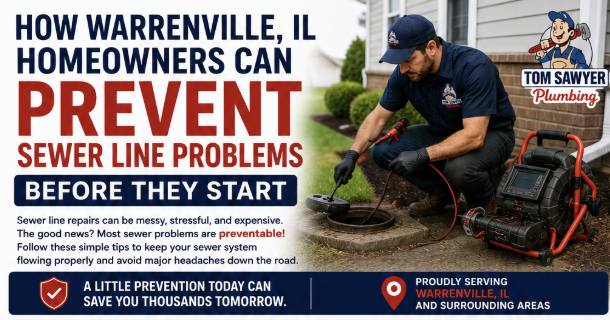
If any of these sound familiar, a sewer camera inspection gives you a clear, real-time view of the pipe interior so you can see exactly what you are dealing with before any digging or guessing.
Prevention Strategies That Actually Work
Schedule a camera inspection every 2 to 3 years. This is especially important for homes with mature trees near the sewer lateral or homes with original clay tile or cast iron pipes. A camera inspection catches root intrusion, cracks, bellies, and buildup long before they cause a backup.
Be careful what goes down the drain. The sewer line handles human waste and water. It is not designed for grease, cooking oil, wipes (even ones labeled “flushable”), feminine products, cotton swabs, or food scraps. Every one of these items contributes to blockages over time. Kitchens are the worst offenders – the same grease accumulation process that causes grease trap problems in commercial kitchens happens in residential lines too, just slower.
Keep roots in check. If you know roots are near your line, ask your plumber about preventative root cutting during routine maintenance. Mechanical root cutting removes growth inside the pipe before it reaches a critical mass.
Fix small problems immediately. A partial blockage today is a full backup tomorrow. If you notice any of the warning signs above, do not wait for it to resolve on its own. Sewer problems do not heal. They escalate.
What Happens When Prevention Is Too Late
If a sewer line is too damaged for simple clearing – meaning the pipe has collapsed, separated, or developed a significant belly (a low spot where waste pools) – the line needs repair or replacement.
Traditional sewer line replacement involves excavating a trench from the house to the street, removing the old pipe, and installing new PVC. This is effective but disruptive, especially if the line runs under a driveway, patio, or landscaping.
Trenchless methods like pipe lining and pipe bursting can sometimes rehab a damaged line without full excavation. Your plumber can recommend the best approach based on what the camera inspection reveals.
For Warrenville homeowners facing this decision, the sewer line repair and replacement service page covers the process and what to expect.
The Illinois Plumbing Code, administered by the Illinois Department of Public Health, sets standards for sewer line materials, slope, and connections. Any repair or replacement work should comply with current code requirements to avoid inspection issues down the road.
Keep Your Warrenville Sewer Line Healthy for the Long Haul
The best time to find out about a sewer line problem is before it shows up in your basement. Tom Sawyer Plumbing LLC serves Warrenville and all DuPage County communities within a 30-mile radius of our West Chicago shop. We can inspect, clear, and repair sewer lines – and we will tell you exactly what we find with no surprises.
Call (630) 849-9265 to schedule a sewer camera inspection or ask about a preventative maintenance plan.