There is a moment every Warrenville homeowner eventually faces: the water heater starts acting up, and you have to decide whether to fix it one more time or replace the whole unit. It is not always an obvious call, and making the wrong choice in either direction costs money.
Replace too early and you throw away years of remaining life. Repair too late and you pour money into a unit that fails completely a few months later – sometimes catastrophically, with 40 or 50 gallons of water flooding your utility room or basement.
This post will help you read the signs, understand the real lifespan of a residential water heater, and make a clear-headed decision based on the condition of your specific unit – not a generic rule of thumb.
How Long Water Heaters Actually Last in DuPage County Homes
Most conventional tank-style water heaters are designed to last 8 to 12 years. Tankless units typically last 15 to 20 years with proper maintenance. But those are manufacturer estimates under ideal conditions. Real-world lifespan depends heavily on water quality, usage patterns, and maintenance history.
In Warrenville and across DuPage County, the water supply carries moderate mineral content. That mineral load accelerates sediment buildup inside tank-style heaters, which is the single biggest factor in premature failure. A unit that might last 12 years in a soft water area may start showing serious problems by year 8 or 9 in this region if it has never been flushed.
The serial number on your water heater usually contains the manufacture date. Most manufacturers encode the month and year in the first four or six characters. If your unit is past the 10-year mark and showing any of the symptoms below, replacement should be on the table.
The Repair-or-Replace Decision: What Actually Matters
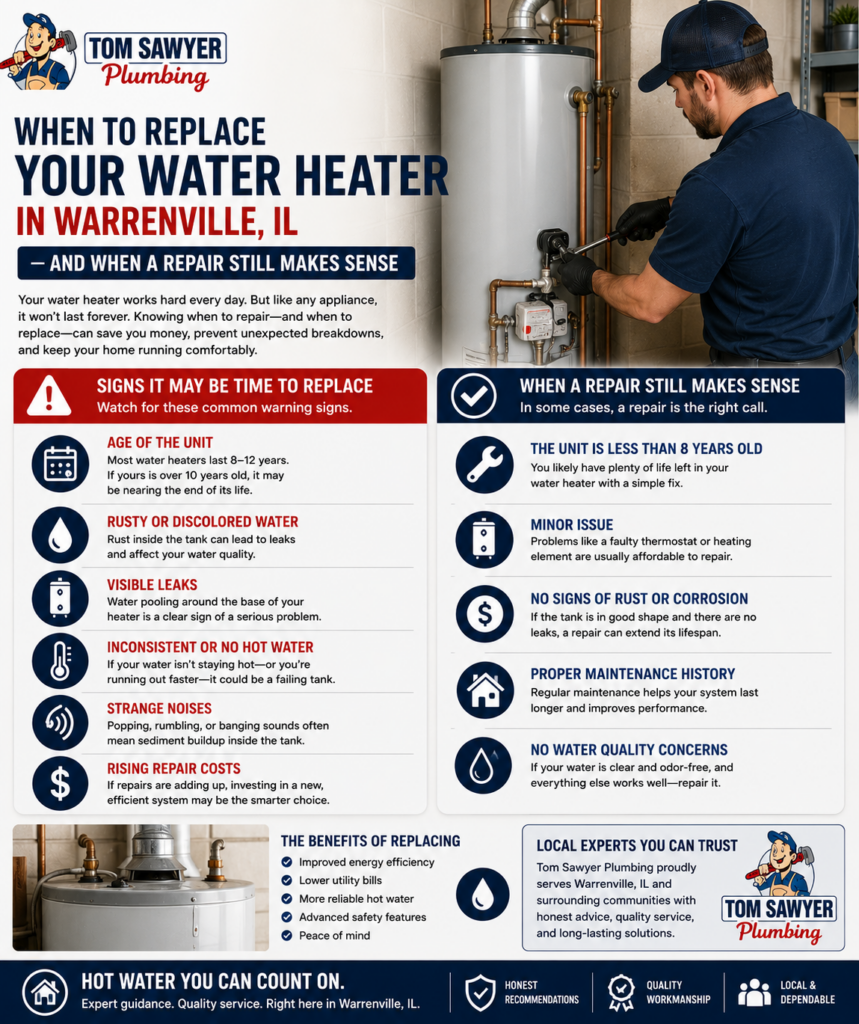
The age of the unit matters, but it is not the whole picture. A 9-year-old water heater with a failing thermostat is worth repairing. A 9-year-old water heater with a corroded tank is not. Here is how to think through it.
Repair usually makes sense when the unit is under 8 years old, the problem is a single component failure (thermocouple, heating element, thermostat, pressure relief valve, anode rod), there is no visible rust on the tank exterior or in the hot water, and the repair cost is under 50% of a new unit installed.
Replacement usually makes sense when the unit is over 10 years old, you are seeing rust-colored hot water from multiple fixtures, the tank itself is leaking (not a fitting – the actual tank body), you have made two or more repairs in the past 18 months, or energy bills have climbed noticeably over the past year with no other explanation.
The gray zone is 8 to 10 years old with a moderate repair. In this range, ask your plumber to inspect the anode rod and the tank interior condition. If the anode rod is heavily depleted and there is visible sediment or scale damage, the tank’s remaining useful life is short regardless of the current repair.
Five Warning Signs Your Warrenville Water Heater Is Failing
Inconsistent water temperature. Hot water that fluctuates between warm and scalding during a single shower usually points to a failing heating element (electric) or a thermostat issue (gas). In older units, it can also mean the dip tube has deteriorated, allowing cold incoming water to mix with hot water at the outlet.
Rumbling, popping, or banging sounds. This is the most recognizable symptom of sediment buildup. Mineral deposits settle at the bottom of the tank and harden over time. When the burner fires, water trapped beneath the sediment layer superheats and creates small steam eruptions – that is the popping sound. The thicker the sediment layer, the louder and more frequent the noise.
Rusty or discolored hot water. If rust-colored water comes only from the hot side (not the cold), the tank is corroding from the inside. Once a steel tank starts rusting internally, there is no repair. The corrosion will continue until the tank develops a leak.
Visible moisture or pooling around the base. Small drips from the tank body or the temperature and pressure (T&P) relief valve indicate internal pressure problems or tank wall failure. Do not ignore even a small amount of water under the unit – tank failures can escalate from a slow drip to a full rupture with little warning.
Rising energy costs with the same usage. A water heater struggling against sediment buildup runs longer cycles and burns more fuel or electricity to maintain the set temperature. If your gas or electric bill has crept up over the past year and your usage has not changed, the water heater is a prime suspect.
The Warrenville water heater repair page covers additional details on service options specific to this area.
Should You Consider Switching to Tankless?
If you are replacing a tank-style unit anyway, it is worth evaluating whether a tankless water heater makes sense for your household. Tankless units heat water on demand rather than storing a preheated supply, which eliminates standby energy loss and provides a continuous flow of hot water.
The upfront cost is higher – typically two to three times the cost of a standard tank unit installed. But the operating cost is lower, the lifespan is roughly double, and you eliminate the risk of a tank rupture flood entirely.
Tankless is not the right fit for every home. Households with very high simultaneous hot water demand (multiple showers, dishwasher, and laundry running at the same time) may need a larger unit or multiple units to keep up. Your plumber can size the system based on your actual usage.
The water heater and tankless water heater service page has a more detailed comparison of both systems.
The Hidden Risk of Waiting Too Long
The worst-case scenario with a failing water heater is not losing hot water for a day. It is a tank rupture that dumps dozens of gallons of water across your floor in minutes. If the unit is in a finished basement, a main-floor closet, or anywhere near drywall, flooring, and stored belongings, the water damage from a single rupture event can easily exceed the cost of a new water heater by five to ten times.
Warrenville homeowners who have dealt with basement flooding already know how quickly water damage escalates. A proactive replacement on your schedule is always cheaper and less stressful than an emergency replacement on the water heater’s schedule.
What a Replacement Involves
A standard tank water heater replacement in a Warrenville home typically takes half a day. The plumber disconnects and drains the old unit, removes it, sets the new unit in place, connects the water lines and gas line (or electrical), verifies proper venting, checks the T&P valve discharge, and tests the system.
If you are switching from tank to tankless, the installation is more involved because it may require gas line upsizing, new venting, and electrical work. A licensed plumber who handles gas line work can manage the full scope so you are not coordinating multiple contractors.
All water heater installations in Illinois must comply with the Illinois Plumbing Code administered by the Illinois Department of Public Health, including proper venting, relief valve discharge piping, and seismic strapping where required.
Maintenance That Extends the Life of a New Unit
Once you invest in a new water heater, a small amount of annual maintenance protects that investment:
Flush the tank once a year to remove sediment before it hardens. Check the anode rod every two to three years and replace it when it is heavily corroded – this is the sacrificial component that protects the tank walls. Test the T&P relief valve annually by lifting the lever briefly and confirming water flows through the discharge pipe. Keep the area around the unit clear of storage, dust, and debris, especially around the air intake on gas models.
In a hard water environment like West Chicago and the surrounding DuPage County communities, adding a water treatment system at the point of entry can dramatically slow sediment accumulation and extend the life of your next water heater well beyond the average.
Get an Honest Assessment Before You Decide
Tom Sawyer Plumbing LLC serves Warrenville and all DuPage County communities within a 30-mile radius. If your water heater is acting up and you are not sure whether to repair or replace, we will inspect the unit, tell you exactly what we find, and give you options – not a pressure pitch.
Call (630) 849-9265 to schedule a water heater evaluation. We will help you make the right call for your home and your budget.
For tips on getting more years out of your next unit, read our guide on extending the lifespan of your water heater. If you are unsure what caused the failure, the most common reasons water heaters stop working covers each scenario.