Quick Answer: West Chicago and DuPage County require backflow prevention devices on water service connections that pose a contamination risk to the public water supply. This includes properties with irrigation systems, boilers, fire suppression systems, and certain commercial operations. Devices must be tested annually by a certified inspector. If your property has one of these connections and you are not in compliance, you could face violation notices or water service interruption.
Most West Chicago homeowners never think about water flowing backward through their pipes. Water comes in from the city main, goes to your faucets, and that is the end of the story. But under certain conditions, water can actually reverse direction and flow from your property back into the public water supply. That is called backflow, and it is a serious public health concern.
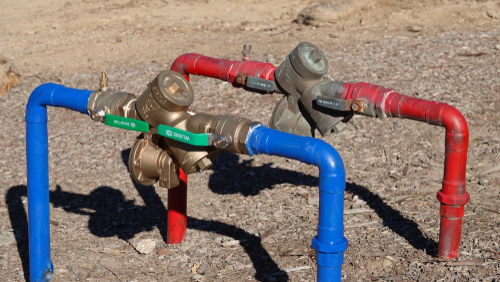
Backflow can pull contaminated water from irrigation systems, chemical mixing tanks, boiler loops, or even a garden hose submerged in a swimming pool back into the clean drinking water supply. A backflow preventer is a mechanical device installed on the water service line that allows water to flow in one direction only, blocking any reverse flow.
West Chicago and DuPage County have specific requirements around backflow prevention, and property owners are responsible for compliance.
How Backflow Happens
Backflow occurs in two ways: backpressure and backsiphonage.
Backpressure happens when the pressure on your side of the connection exceeds the supply pressure. This can occur with booster pumps, thermal expansion in heating systems, or pressurized equipment connected to the water supply.
Backsiphonage happens when the supply pressure drops suddenly, creating a vacuum that pulls water backward through the connection. A water main break, hydrant flushing, or heavy fire department water use in the neighborhood can all cause temporary pressure drops that trigger backsiphonage.
In either case, whatever is on your side of the connection, whether it is fertilizer from a lawn sprinkler system, chemicals from a commercial cleaning operation, or stagnant water from an unused line, can be drawn into the public water supply and reach your neighbors.
What DuPage County and West Chicago Require
The City of West Chicago Public Works Department administers a Cross-Connection Control Program in partnership with Backflow Solutions, Inc. (BSI). This program requires property owners with certain types of water connections to install approved backflow prevention assemblies and have them tested annually by a certified Cross Connection Device Inspector (CCDI).
Common connections that trigger the requirement include lawn irrigation systems (one of the most common for residential properties), hydronic heating or boiler systems, commercial dishwashers, dental or medical equipment, fire sprinkler systems, and any connection where a chemical or non-potable substance could contact the water supply.
If your property has a backflow device, BSI will send reminders when testing is due. Test reports are filed with a Customer Confirmation Number (CCN). Failure to test or failure to repair a non-functioning device can result in violation notices.
Residential vs. Commercial Requirements
For most West Chicago homeowners, the backflow requirement is triggered specifically by an irrigation system. If your home has an in-ground sprinkler system connected to the potable water supply, you are required to have a backflow preventer installed and tested annually.
For commercial properties, the requirements are broader. Restaurants, medical offices, auto shops, dry cleaners, and any business that uses chemicals or has equipment connected to the water line typically need backflow protection. The DuPage County Water Division enforces these requirements across the county for unincorporated areas, and each municipality manages compliance within its own boundaries.
If you own or operate a business and are unsure whether your property is compliant, your plumber can perform an inspection and identify any cross-connections that need protection.
Types of Backflow Preventers
The type of device required depends on the degree of hazard at the connection point.
Reduced Pressure Zone (RPZ) assemblies provide the highest level of protection and are required for high-hazard connections such as chemical feeds, boilers, and medical equipment. They have two check valves and a relief valve that dumps water if either check fails.
Double Check Valve Assemblies (DCVA) are used for lower-hazard connections like fire sprinkler systems and some irrigation setups. They have two check valves but no relief valve.
Pressure Vacuum Breakers (PVB) are commonly used for residential irrigation systems. They are less expensive than RPZ assemblies and are adequate for backsiphonage protection on irrigation connections where the device can be installed above the highest sprinkler head.
Your plumber can recommend the correct device based on the type of connection and the hazard level. Installation must comply with the Illinois Plumbing Code, and the device must be accessible for annual testing.
What Annual Testing Involves
Annual testing is a quick process performed by a certified inspector. The inspector uses a differential pressure test kit to verify that each check valve is sealing properly and that the relief valve (on RPZ assemblies) is functioning. The test takes about 15 to 20 minutes per device.
If the device fails the test, it must be repaired or replaced and retested. Common failure causes include worn check valve seats, debris lodged in the valve, and corrosion from age or water quality. In areas with hard water like West Chicago, mineral buildup can accelerate wear on internal components.
What Happens If You Are Not in Compliance
West Chicago takes cross-connection control seriously because a single unprotected connection can contaminate the water supply for an entire section of the distribution system. Property owners who fail to install required devices, fail to test on schedule, or fail to repair failed devices can face escalating notices, fines, and in extreme cases, water service disconnection.
The most common compliance issue is not a missing device but a missed test. Many homeowners install the device when the irrigation system goes in and then forget about the annual testing requirement. If you have received a letter from BSI or the City referencing your CCN, that is your reminder to schedule testing.
Installation, Testing, and Repair in One Call
Tom Sawyer Plumbing LLC installs, services, and repairs backflow prevention devices for residential and commercial properties throughout West Chicago and surrounding DuPage County communities. If you need a new device installed, an existing one repaired, or you are not sure whether your property requires one, we can evaluate your connections and bring you into compliance.
Call (630) 849-9265 to schedule a backflow preventer inspection or installation.
Tom Sawyer Plumbing LLC installs and tests backflow prevention devices for homeowners and businesses in Bartlett, Geneva, and all DuPage County communities.