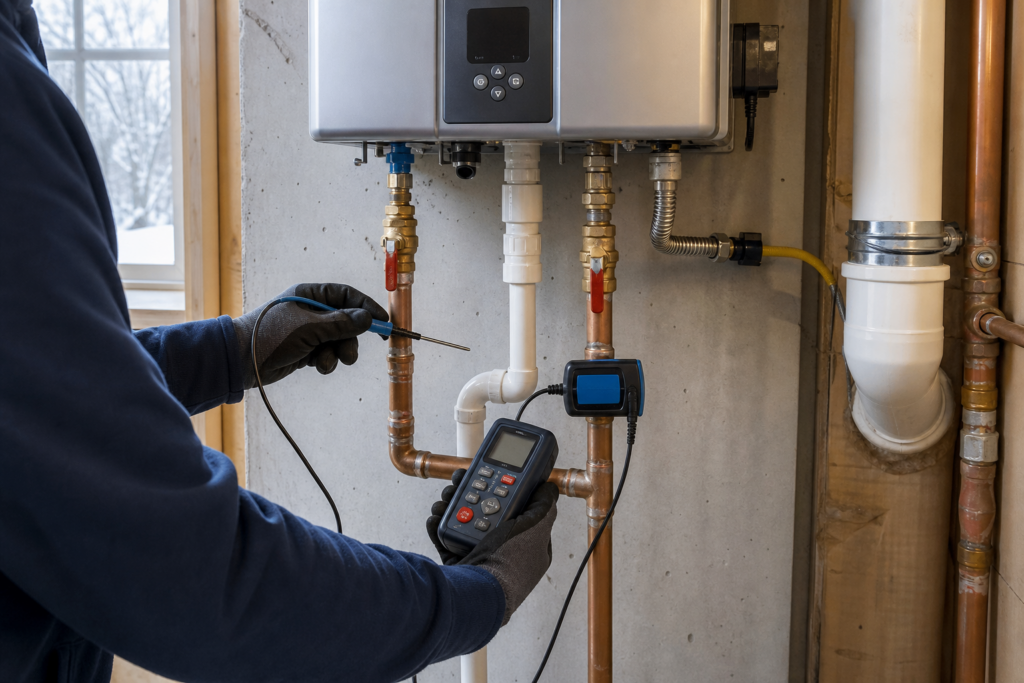
A West Chicago home needs a tankless water heater that can supply the total hot-water flow likely to be used at one time while producing the required temperature rise. Square footage and household size provide context, but they do not determine capacity by themselves. The right unit depends on which showers, faucets, and appliances may run together, how cold the incoming water is, and whether the home’s gas, electrical, venting, and plumbing systems can support the selected equipment.
Start With Simultaneous Hot-Water Demand
Tankless water heaters produce hot water as it is needed, so sizing begins with peak simultaneous demand. The question is not how much hot water a household uses throughout an entire day. It is how much must be delivered during the busiest part of that day.
A household may regularly use one shower at a time with little other hot-water demand. Another may run multiple showers while a dishwasher or washing machine is operating. Those homes can have similar floor plans but require different tankless capacities.
A sizing assessment should identify every fixture and appliance that may draw hot water. It should then separate possible demand from realistic demand. Adding every fixture in the house can lead to an unnecessarily large recommendation if those fixtures are never used together. Ignoring normal overlapping use can result in a system that struggles when the household is busiest.
Temperature Rise Affects Available Flow
Flow rate is only half of the sizing calculation. The unit must also raise incoming water to the desired delivery temperature.
Incoming water can be colder during West Chicago winters than it is during warmer weather. When the temperature difference between incoming and delivered water increases, the heater must work harder. A model that supports a certain flow under mild conditions may provide less flow when a greater temperature rise is required.
Manufacturer capacity information should therefore be reviewed at the temperature rise expected for the home. Comparing units only by their largest advertised flow rating can create an unrealistic expectation. A technician can evaluate incoming water conditions and match the home’s demand to a unit’s performance at the appropriate temperature rise.
List the Fixtures That May Run Together
A practical fixture-use plan helps turn household habits into a realistic capacity requirement. Homeowners should consider morning routines, evening cleanup, laundry schedules, and whether guests regularly increase demand.
Important questions include:
- Are multiple showers commonly used at the same time?
- Does the dishwasher run while someone is bathing?
- Is hot-water laundry part of the household’s normal peak period?
- Are there high-flow fixtures, large tubs, or specialty plumbing features?
- Could a bathroom, appliance, or finished living area be added later?
This review should focus on the home’s actual routine. A household that staggers showers and appliance use may need less simultaneous capacity than one where several people prepare for work or school at the same time.
Do Not Size the Unit From the Old Tank Alone
Replacing a storage water heater with a tankless system is not a direct capacity-for-capacity swap. A tank stores a fixed volume of heated water, while a tankless unit continuously heats water as it flows through the equipment.
The old tank’s size may help describe past household use, but it does not establish the required tankless flow rate or temperature rise. It also does not account for changes in fixtures, occupancy, routines, or future plans.
The existing water heater’s performance can still provide useful clues. Frequent hot-water shortages, long recovery periods, or inconsistent temperatures may indicate that the previous system did not fit current demand. Those observations should inform the evaluation without becoming the only basis for the new equipment choice.
Confirm the Home Can Support the Selected System
Proper sizing also depends on installation conditions. A unit may have enough heating capacity on paper but still be a poor fit if the supporting utilities or installation location cannot meet its requirements.
For a gas-fired unit, the evaluation may include the available fuel supply, gas-line capacity, venting route, combustion-air requirements, and condensate handling when applicable. An electric model requires a review of the electrical service, panel capacity, circuit requirements, and installation space.
The plumbing layout matters as well. Pipe routing, distance to fixtures, existing recirculation equipment, water pressure, and water quality can affect comfort and installation planning. These conditions do not replace the demand calculation, but they help determine which correctly sized option can be installed safely and operate as intended.
Homeowners considering tankless water heater installation should expect the equipment recommendation and the installation plan to be evaluated together.
Avoid Choosing a Unit That Is Too Small or Unnecessarily Large
An undersized tankless water heater may struggle when demand increases. Homeowners may notice reduced flow, inconsistent temperature, or difficulty using multiple hot-water fixtures together.
Choosing the largest available unit is not automatically the best solution. A larger model may require utility upgrades or installation work that the home does not otherwise need. Equipment should provide enough capacity for realistic peak use, appropriate temperature rise, and reasonable future needs without treating every possible fixture combination as an everyday event.
The goal is balanced capacity: enough output for the household’s routine, supported by the home’s utilities, with installation conditions that match the manufacturer’s requirements.
Prepare for a Tankless Water Heater Sizing Visit in West Chicago
Before an evaluation, note which hot-water fixtures are commonly used together, when shortages or temperature changes occur, and whether the household expects renovations or changing demand. It also helps to identify the current water heater, utility type, installation location, and any known plumbing or electrical concerns.
A professional sizing visit can confirm fixture demand, incoming-water conditions, utility capacity, venting or electrical requirements, and the most practical installation location. To arrange a home-specific assessment, contact Tom Sawyer Plumbing and describe the household’s busiest hot-water routine.