Quick Answer: If your garbage disposal hums but does not spin, the flywheel is jammed. If it does nothing at all, check the reset button on the bottom of the unit and verify power at the switch or outlet. If it leaks from the bottom, the internal seal has failed and the unit needs replacement. Most jams and resets are DIY fixes. Leaking units, repeated tripping, and units older than 10 years are usually better off replaced. Never put your hand inside a running or powered disposal.
A garbage disposal is one of those kitchen fixtures that works so reliably for so long that you forget it is a mechanical device with moving parts, seals, and an electric motor. Then one morning it refuses to turn on, or it hums without spinning, or you notice a puddle of water under the sink, and suddenly you realize how much you relied on it.
Most garbage disposal problems in Winfield homes fall into a handful of categories, and many of them can be resolved without a service call. Here is how to diagnose the issue, what you can safely try yourself, and when the problem requires a plumber.
The Disposal Hums but Will Not Spin
This is the most common garbage disposal problem, and it means the flywheel is stuck. Something hard, usually a bone fragment, fruit pit, piece of glass, or small utensil, has wedged between the flywheel and the shredder ring and the motor cannot turn.
First, turn the disposal off at the switch and unplug it or kill the breaker. Never attempt to free a jam with the unit powered. Most disposals come with an Allen wrench that fits into a hex socket on the bottom of the unit. Insert the wrench and turn it back and forth to manually rotate the flywheel and dislodge the obstruction.
If you do not have the wrench, a 1/4-inch Allen key from any hardware store fits most models. After freeing the jam, remove the obstruction from inside the chamber (use tongs or pliers, not your hand), press the reset button on the bottom of the unit, and test.
If the flywheel spins freely with the wrench but the motor still only hums when powered, the motor may be burned out from straining against the jam. That is a replacement situation.
The Disposal Does Absolutely Nothing
If the disposal makes no sound at all when you flip the switch, check the reset button first. The reset is a small red or black button on the bottom of the unit. If the motor has overloaded, the button pops out. Push it back in and try the switch again.
If the reset does not help, check the power source. If the disposal is plugged into an outlet under the sink, verify the outlet has power by plugging in something else. If the disposal is hardwired, check the breaker panel for a tripped breaker.
If power is confirmed and the reset is engaged and the motor still does not respond, the motor has likely failed. On a unit that is 8 to 10 years old or older, replacement is more cost-effective than motor repair.
The Disposal Leaks
Disposal leaks can come from three places, and the source determines whether it is a repair or replacement.
Leak from the top flange (where the disposal meets the sink). This usually means the mounting ring has loosened or the plumber’s putty seal has deteriorated. Tightening the mounting hardware or reseating with fresh putty often fixes it.
Leak from a side connection (dishwasher inlet or drain pipe). These connections use hose clamps or compression fittings that can loosen over time. Tightening the clamp or replacing the gasket usually resolves it.
Leak from the bottom of the unit. This means an internal seal has failed and water is reaching the motor housing. There is no repair for this. The unit needs to be replaced.
If you are dealing with persistent drain issues in the kitchen alongside disposal problems, the issue may extend beyond the disposal itself. Professional drain cleaning can clear buildup in the drain line downstream of the disposal that is causing slow drainage or backups.
What Never Goes in a Garbage Disposal
A lot of disposal problems are caused by putting the wrong things through the unit. The disposal is designed to grind small amounts of soft food waste, not to be a trash can.
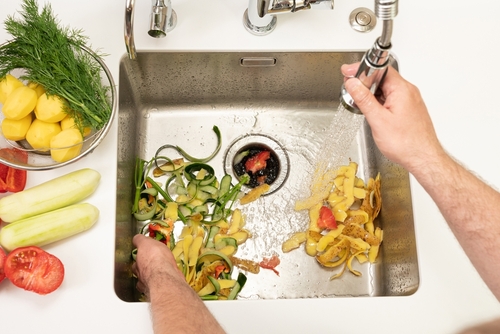
Items that cause the most problems: bones, fruit pits, corn husks, celery and fibrous vegetables (they wrap around the flywheel), egg shells (the membrane lining creates a paste), grease and cooking oil (they solidify in the drain line), coffee grounds (they accumulate and form a dense plug), and pasta or rice (they expand with water and pack tightly).
The grease issue is the same process that causes drain problems throughout the kitchen and is the number one reason residential kitchen drains clog over time.
Repair vs. Replace: The Quick Test
If the disposal is under 5 years old and the problem is a jam or an electrical reset, repair it. If the disposal is 8 to 10 years old and the problem is recurring jams, a leak from the bottom, or a motor that no longer sounds right (grinding, screeching, or rattling that was not there before), replace it. A new disposal installed by a plumber who handles fixture work typically costs less than two repair visits on an old unit.
Get Your Winfield Kitchen Running Again
Tom Sawyer Plumbing LLC serves Winfield and all surrounding DuPage County communities. Whether you need a disposal unjammed, replaced, or properly connected to your existing drain line, we handle it on one visit with no surprise charges.
Call (630) 849-9265 to schedule a garbage disposal repair or replacement.